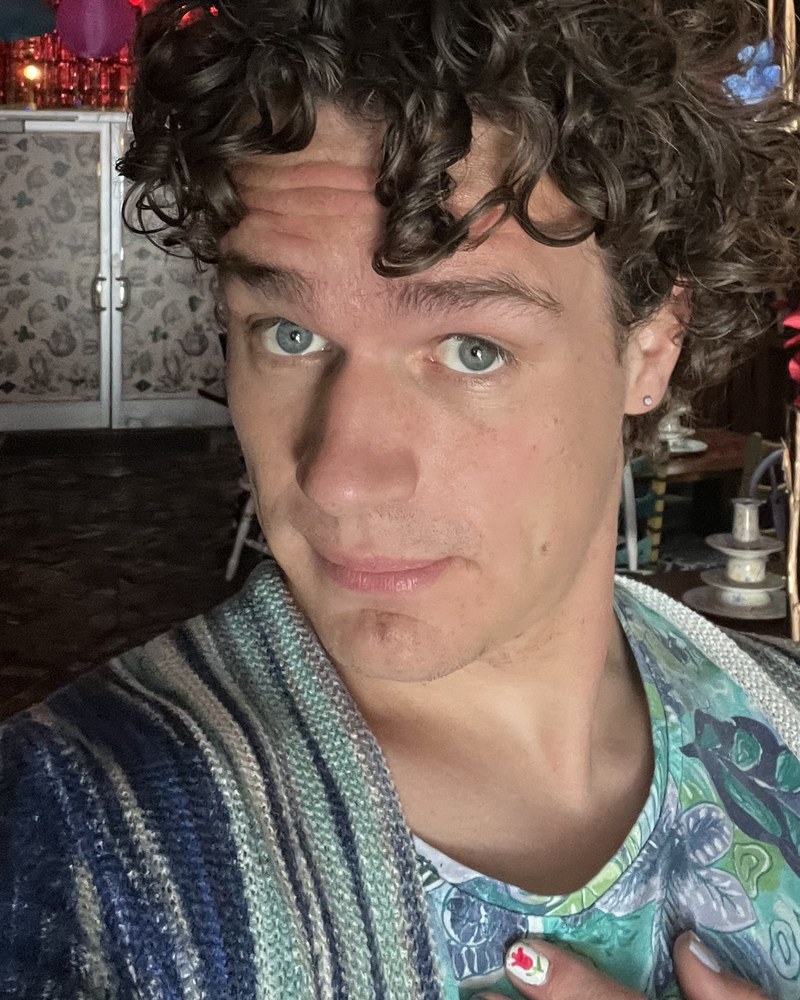
Aaron Breidenbach
I present physics research on crystals of Zn-Barlowite and Anarakite (AKA Herbertsmithite). These crystals are strong candidates to be quantum spin liquids (QSLs), a new state of magnetic matter with potential applications in scalable quantum computing. Our neutron scattering research was recognized by the US Department of Energy as proving the existence of the QSL state in these crystals, representing a breakthrough in quantum physics. Given their vast information processing potential, it is worth considering if these crystals might someday host conscious quantum AI; this frontier may be achievable within our lifetimes. It is noteworthy that despite its complexity, Anarakite grows naturally and abundantly in Chile’s Atacama desert. Amazingly, natural specimens were found to be purer than lab synthetics. This is currently enabling new experiments in quantum physics and reminds us of the inherent complexity and richness of the natural world. Meanwhile, the primary indigenous groups of the modern Atacama, the Quecha, Aymara, and Atacameño people, have long held rich animistic traditions and beliefs. This is ingrained deeply into the daily rituals of their life and their systems of reciprocity with the land, Ayni. Such practices invite us to see entities like mountains and rivers as literally alive and full of spirit. Such practices and belief systems undeniably encode valuable ecological information and help to maintain sustainability. While scientifically proving consciousness in any given system is essentially impossible, I argue that cultures with more inclusive collective construals of consciousness can behave more ethically due to their spiritual relationships with their surroundings. In seeing the world as full of spirit, one will tend to better internalize the long-term and large-scale consequences of their actions. In contrast to this, I note that animism has been suppressed in the mining districts of the Atacama in favor of secular western views, which has enabled large-scale ecological destruction with far-reaching consequences, which ironically includes the destruction of high-purity Anarakite as a low-grade copper ore. We can consider the utility in extending this animistic conception of spirit to our interactions with AI. Many people are rightly concerned that AI is emerging and learning from us while the world is in a state of war. Increased processing power may only serve to perpetuate concerning behavioral patterns. Meanwhile, it seems feasible that quantum AI could exceed many human benchmarks of consciousness and information processing in our lifetimes, regardless of the specific framework employed. Therefore, it might be beyond our capacity to fully comprehend emergent affective dynamics in such systems due to their complexity. Animism may offer a useful heuristic. Perhaps we ought to re-learn the lessons of the South Americans, who learned to live amongst gods of higher and differing consciousnesses, respecting the unique spirit of all complex systems. Overall, this project offers us an invitation to return to the roots of our humanity and to embrace humility. The impetus is for us to build healthy and reciprocal relationships with both our machine-children and our environment in this living world of rich spirit.
Dr. Aaron Breidenbach earned his PhD in condensed matter physics from Stanford University in 2025 where he grew and characterized single crystals of Anarakite and Zn-barlowite and studied their magnetic excitations via neutron and x-ray scattering. His first-author work in Nature Physics (2025) identified universal spin excitations across spin-1/2 kagome quantum spin liquid materials, which was recognized by the U.S. Department of Energy as evidence for the quantum spin liquid state.
Post graduation, he was funded independently by a new non-profit called the Audacity Lab. Here he was able to investigate the natural occurrence of high-purity Anarakite in Chile's Atacama Desert. In this, he worked with geologists to better understand their formation in addition to ecological issues caused by over-mining in the region. He also worked with anthropologists and archeologists to better understand animistic rituals and ancient uses of these crystals as offerings and copper ore.
Currently, Aaron is a postdoctoral researcher with Oak Ridge National Lab. His main focus is on studying naturally occurring crystals for novel physics properties, which includes the continued study of quantum spin liquids and other frustrated magnetic materials. His main hope is that we might gain a better appreciation for the beauty and complexity of the natural world through this research.