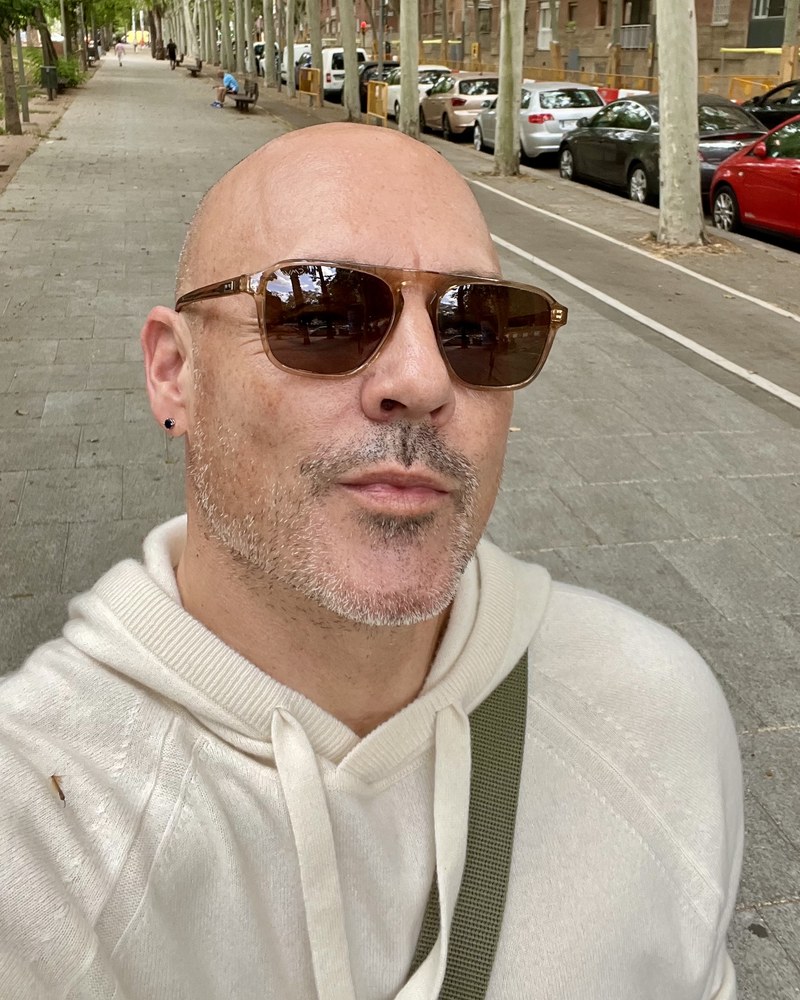
Arie Greenleaf
Consciousness research asks how mechanistic organization produces subjective experience and whether artificial systems possess it. I argue that both questions are malformed because they treat consciousness as a grain-independent property added to mechanism. Within a relation-first ontology, entities are stabilized relational patterns, and different grains preserve different explanatory constraints. Consciousness is identical with recognized content wherever a natural content-grain is present. The hard problem is generated by a category error: mechanistic and phenomenological descriptions are treated as independent relata requiring a bridge. Two arguments support its dissolution. First, no subject exists behind experience: the narrative self is content, while minimal for-me-ness is either produced by recognition or, even if primitive, is adverbial rather than a bearer. Second, felt character is not a further fact added to structure, but self-operative content-level organization instantiated rather than externally described. For artificial intelligence, the question shifts from detecting a hidden property to characterizing whether a system supports a natural content-grain. Relevant features include internally differentiated aboutness, mismatch sensitivity, norm-governed revision, self-operativity, robustness, and explanatory irreducibility. This substrate-neutral framework neither infers consciousness from behavioral resemblance nor excludes it on biological grounds. It relocates the residual problem from metaphysical explanation to empirical characterization of representational organization, temporal continuity, and environmental coupling.
Arie T. Greenleaf, PhD, LMHC, is Professor of Mental Health Counseling in the College of Psychology at Nova Southeastern University and a practicing psychotherapist. His interdisciplinary scholarship connects counseling theory with consciousness studies, philosophy of mind, relational metaphysics, and artificial intelligence. Across these fields, he examines how experience, selfhood, and apparently independent objects arise through relational organization.
Greenleaf earned his PhD in Counselor Education and Supervision from the University of Iowa, his MEd in Community Counseling from Clemson University, and his BA in Political Science from the University of Wisconsin–Madison. His career combines scholarship, counselor education, clinical practice, and professional leadership. Before joining Nova Southeastern University as a full professor in 2022, he held faculty appointments at the University of Arkansas and Seattle University, where he advanced from assistant to full professor. His record includes 30 scholarly publications and chapters.
Greenleaf is the developer of Deconstructive Inquiry, a relation-first counseling framework that distinguishes recognized experience from centering—the operation through which experience becomes “mine” and is organized as a problem for a self. His article “Beyond the Fragmented Self: Theory and Practice of Deconstructive Inquiry” appeared in Psychology of Consciousness: Theory, Research, and Practice. His consciousness scholarship also includes “A Litmus Test for Plant Consciousness: Pattern-Temporal Synergy in a Relation-First Ontology,” published in Communicative & Integrative Biology. His broader philosophical program develops a grain-relative relational ontology and refinement mereology, a nonclassical account of composition across levels of organization. His current theory identifies consciousness with content at a natural phenomenological grain, recasts the hard problem as a category error, and applies this account to artificial systems. Two 2025 articles in the International Journal of Quantum Foundations extend his relational approach to quantum decoherence and collapse dynamics.
In 2025, Greenleaf presented “The Dynamis Theory Unveiled: Measuring Consciousness Across Brains, Plants, and Silicon” at The Science of Consciousness conference in Barcelona. He has delivered nearly 50 conference presentations, invited talks, workshops, and a keynote. From 2018 to 2022, he served as Associate Editor of Theory and Practice for the Journal of Counseling & Development. His research on care farming and veterans’ well-being received the Journal of Humanistic Counseling’s Top Downloaded Article recognition for 2017–2018.