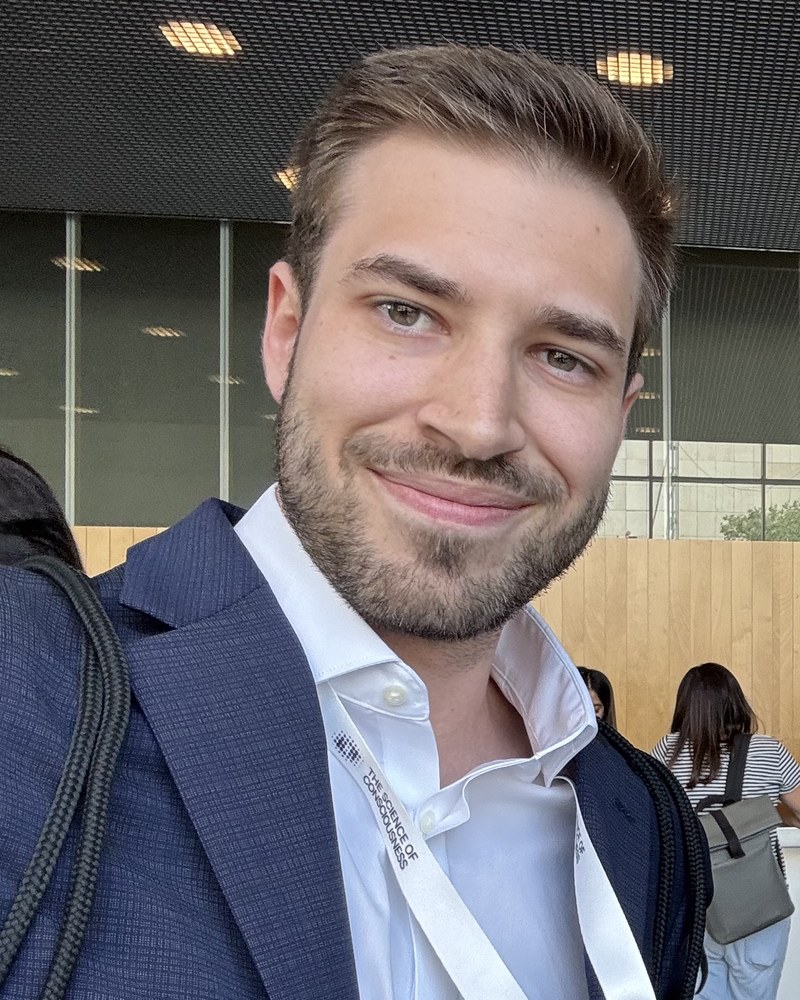
Benjamin Liljedahl
The Hameroff–Penrose hypothesis, known as Orchestrated Objective Reduction (Orch-OR), continues to attract both significant discussion and controversy. The theory posits both 1) that the biological basis of consciousness is constituted by certain quantum mechanical events within microtubules, called 'objective reduction' events, and 2) that all such events instantiate proto-experiential, or 'protophenomenal', properties. Hence, Hameroff classifies his theory as 'panprotopsychism', a view which sits somewhere in between physicalism and panpsychism. At the same time, monistic idealism has received increasing attention within contemporary philosophy of mind, with proponents including Bernardo Kastrup, Donald Hoffman, Rupert Spira, Tom Campbell, Deepak Chopra, and Federico Faggin. Unlike Orch-OR, idealism posits phenomenal consciousness as ontologically primary, rather than being dependent upon quantum mechanical processes. The central question to be addressed in this presentation is: Can these two paradigms be synthesized? I argue that they can, if we restrict Orch-OR’s explanatory domain to the 'binding problem': the question of how disparate physical brain structures become integrated into a unified experience. Although idealism is increasingly being seriously considered as our most viable metaphysical ontology, any idealist framework still requires an additional theory to solve the binding problem. I therefore propose that idealism could be correct regarding the ontological nature of consciousness, and Orch-OR could be correct regarding the physical mechanism responsible for phenomenal binding and macro-consciousness, as argued by Michael Wiest. One potentially solves the mind–body problem, and the other potentially solves the binding problem. Regardless of whether either theory ultimately proves to be true, the framework outlined here demonstrates one possible route toward a theoretical unification of monistic idealism and Orch-OR.
Ben Liljedahl is an aspiring philosopher of mind specializing in consciousness. He has a BA in Cognitive Science & Philosophy from the University of Connecticut, where he was awarded the Undergraduate Philosophy Medal. He subsequently earned an MA in Consciousness and Human Potential from Maharishi International University, a program which emphasizes a complementary approach of both theory and contemplative practice. He was voted the best student in the program, earning him the Outstanding Student Award. He has recently completed a second MA degree in Bioethics from New York University, completing his practicum experience at the Center for the Unification of Science and Consciousness, conducting philosophical research on the prospect of AI consciousness. He has given a webinar entitled "Consciousness and Computation," and has been published in the UBC Journal of Philosophical Enquiries. Lastly, he is a student member of the Academy for the Advancement of Postmaterialist Sciences, and presented a poster on panpsychism at the 2025 TSC conference in Barcelona. He is honored to play a small part in the historic paradigm shift occurring in consciousness science.