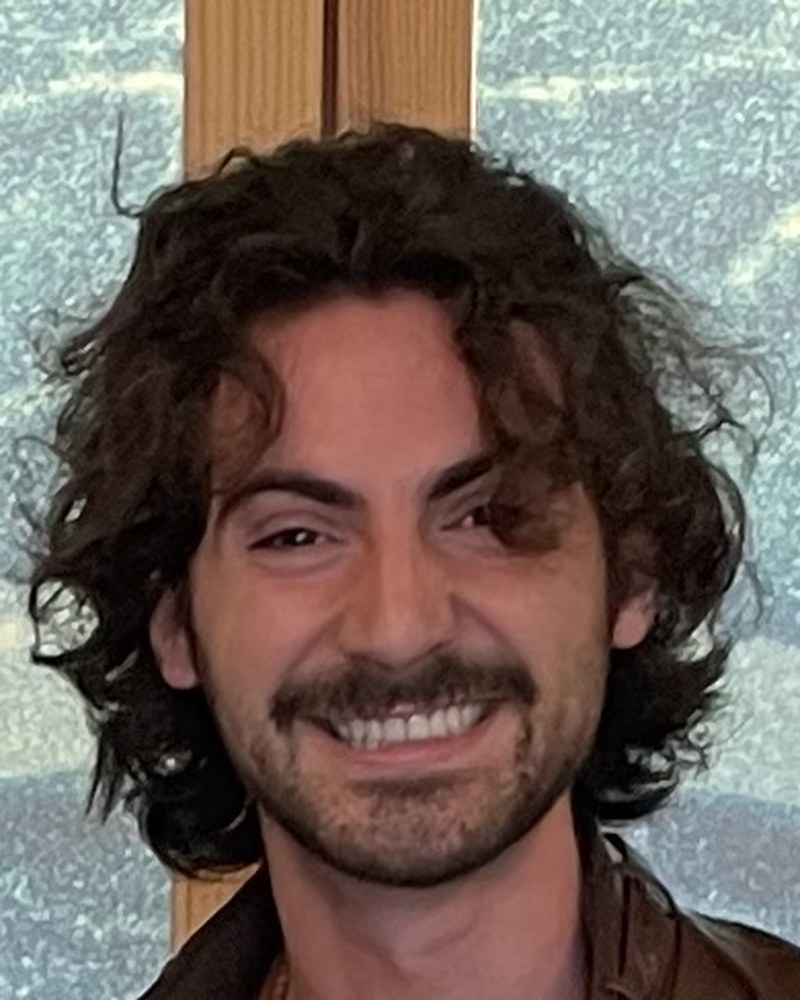
Julian Yocum
Eeshan Tripathii — MIT, Cambridge, Massachusetts, USA
Emiliano Altuzar — MIT, Cambridge, Massachusetts, USA
The study of biological life has revealed evolutionary forces beyond natural selection, which itself accounts for development across generations, but does not account for teleonomic processes during the life of an organism. Central in these processes is morphogenesis, the creation and development of stable structures or forms: differentiation of species, growth of bodies, invention of concepts, etc. René Thom proposed a general theory of morphogenesis and form using the framework of catastrophe theory, rooted in the mathematics of singularities. This allowed the study of qualitative and discrete structure, as opposed to the traditional quantitative and continuous approach of calculus. Extending this spatially-interested field to chronology, was Arthur Winfree’s work in the 1960s on phase singularities in biological oscillators, which were introduced as “time crystals”. Building on this, as well as the work of Penrose and Hameroff, Anirban Bandyopadhyay and collaborators generalized time crystals to polyatomic structures, reasoning that consciousness arises from similar processes on the quantum scale. We present progress toward a mathematical theory of the description and analysis of polyatomic time crystals by building on the established correspondence between singularities and the rotational groups of Platonic solids. We hope such a theory would enable further study of biological quantum phenomena and the geometric musical language of life.
Julian Yocum is a graduate researcher at the Center for Human-Compatible AI at UC Berkeley, where he studies brains, human and artificial. His work has promoted cooperation in AI systems and revealed novel structure in neural representations. His interest lies in foundational questions of science and philosophy, especially those that resist being placed within a single discipline. His aim is to do research which elevates rather than reduces the nature of the human.