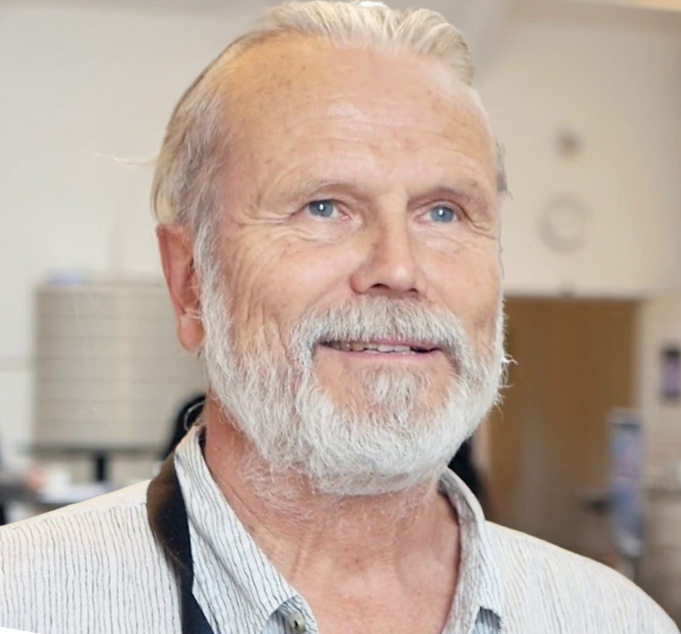
Steen Rasmussen
When and how did life and sentience emerge on Earth - and how can humans create life and sentience today? As there is no generally agreed upon definition of life, we initially present and discuss definitions of life that can be experimentally verified. We then propose how life may have originated on Earth and show how life may be created from scratch in the laboratory. Lab created minimal life, protocells, consist of simple physicochemical systems and for our protocells we can quantify all free energy changes in their lifecycle as well as identify their key kinetic rates. These kinetic rates define a competition between the metabolic production rates and the environmental decay rates where the balance between the two determines whether the system lives or dies. Living processes are physical processes that in contemporary biological systems are implemented in wet carbon chemistry. However, we argue that living processes can also be implemented in software on computers or as embodied robotics systems. In particular, the latest developments of autonomous LLM powered, evolving agents have all the characteristics of living processes.
April 25, 2025:
Steen Rasmussen is a professor in physics at the University of Southern Denmark, an external research professor at the Santa Fe Institute in NM USA, and the head of the Science Board at the European Centre of Living Technology (ECLT).
Since a graduate student, he has mainly focused on how to create life from nonliving materials and studied how living and intelligent technologies change what it means to be human. He has led international research initiatives across the US, EU and Denmark since 2003, and he has won more than $39M in competitive basic research grants to his home institutions and international research consortia. He is an author of 130 peer-reviewed scientific journal papers; he has written and edited 15 scientific books, proceedings and special journal issues; given 200+ invited talks, 150+ media interviews and he has made 30+ consulting & internal reports. His h-index is 46 and his Erdös number is 2.
Dr. Rasmussen received his PhD in Physics 1985 from the Technical University of Denmark. In 1988 he joined Los Alamos National Laboratory and the Santa Fe Institute, both in New Mexico USA, where he worked for 20 years as an Alien of Extraordinary Abilities. In the US he contributed to a variety of interdisciplinary research programs and projects, and in the late 80s he was part of the core group creating the scientific field of Artificial Life. In 2004 he co-founded the European Center for Living Technology (ECLT) in Venice, Italy, and after returning to Denmark in 2008 he founded and headed the Center for Fundamental Living Technologies (FLinT) in 2008 and the Initiative for Science, Society and Policy (ISSP) in 2009. He has consulted on science and technology issues for the European Commission, the Danish Parliament, the German Bundestag, the US Congress, as well as private companies.