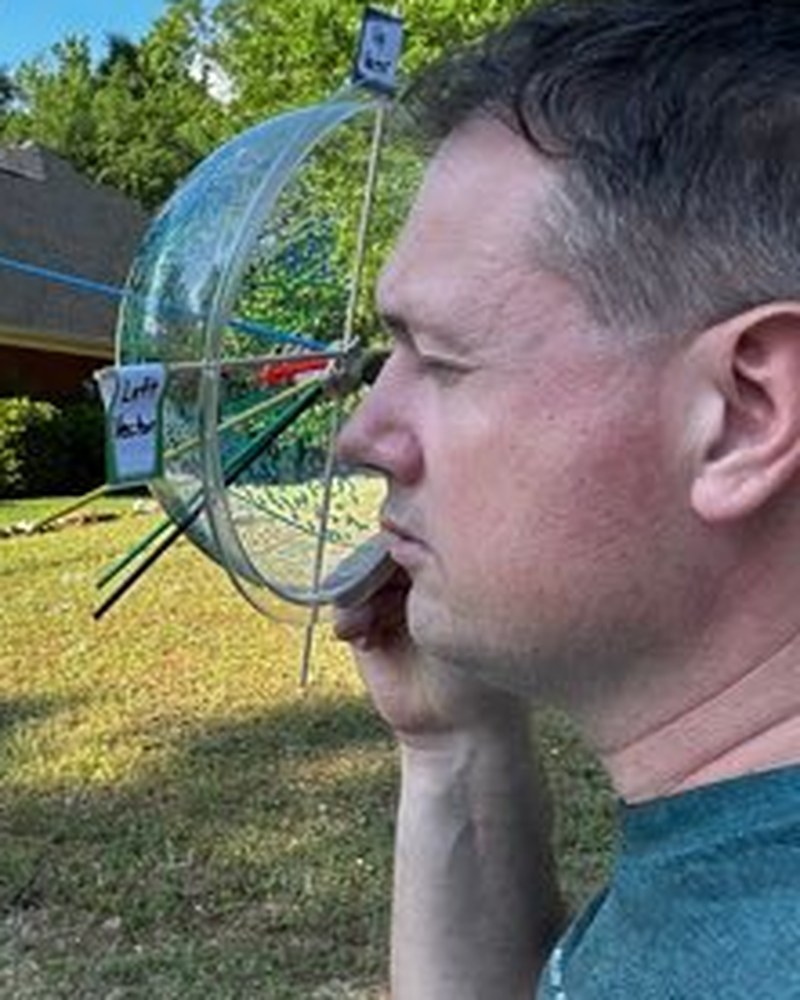
Brad Caldwell
Conscious experience under ordinary waking presents as a smooth integrated continuum; under sustained cannabinoid sedation, the same experience becomes legible as a compositional system whose components can be individually inspected. This presentation surveys four years of structured first-person observation organized into Ring Bank Theory (RBT), a geometric framework in which experience is modeled as the interaction of several pose-able schemas — Bank (B), Real (R), Imaginal (I), Time (T), Access manifold (A), and Peripersonal Space (PPS) — coupled through a Printing Operator Π that samples on A and prints discrete/phasic ringframes ρ into T. Three constraints on any candidate neural correlate (NCC) emerge from a catalog of ~15 first-person cases: (i) Cleanly-switchable content channels (R vs. I). Sedation cases include observations where R cleanly switches to I for a single 100-ms frame and then back. The NCC mechanism must support clean content-channel selection, not merely integrated perception. (ii) Oft-sequencism: 0-to-2π or 0-to-1 division of A. One common Π mode divides A into phase-locked angular or linear positions. The mechanism must support this sort of sequence readout of Bank material. This aligns with sub-population coding accounts in which low-dimensional ring-shaped attractors (PCA rings) host phase-locked content, with synfire chains and traveling waves as candidate implementation substrates. (iii) Full-time pose-shape coupling between schemas. Schemas remain pose-coupled across life: B's morphology (concentric cube/sphere/cylinder shells) hosts A's (ring, horseshoe, spiral, boardbook stack) in regularized ways. The mechanism must support continuous schema-to-schema pose-shape coupling at high temporal resolution. Together, these constraints point toward sub-population coding architectures organized around explicit low-dimensional ring dynamics. We will discuss specific observations as case-level instantiations of these constraints. The companion phenomenology archive, Journal of Ring Bank Phenomenology, catalogs the full case library and is targeted for completion by conference time. The phenomenology catalogued here aligns most closely with published first-person reports of salvia divinorum and iboga states — discrete-frame perception, schema coupling, reference-displaced schema inversions, visibility of flow velocity of past fading frames, and content-channel switching are recurring features in both literatures.
Hold BSCE degree. Presented at 2023 Italy Science of Consciousness conference. Wrote the books Rings of Fire: How the Brain Makes Consciousness (2022) and Perceptual Optics (2023). Currently writing Journal of Ring Bank Phenomenology (2026, expected).