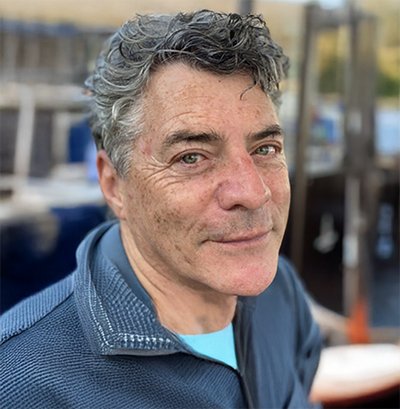
Jonathan Schooler
How does a mind made of many parts move through time as one? Riddle and Schooler's (2024) Nested Observer Windows (NOW) model conceives consciousness as a hierarchy of information-integrating windows, likened to a photomosaic whose every pixel is itself an image. Schooler and Riddle's (2024) three dimensions of time model has these windows moving through time as bodies move through space: objective time along x, subjective time up the z axis, alternative time across y. But if each window independently takes its own vector in alternative time, the mosaic disperses — a mind scattering across countless divergent timelines rather than living a single one. Here I introduce the Kite of Consciousness, which inverts the geometry. Time is the wind; consciousness is the sail. Windows need not travel, only tilt. A sail's pitch controls how much wind it catches: tilted steeply into the flow, time dilates; tilted shallowly, time flies by. Its yaw selects among alternative next moments, while tethers to sibling sails constrain both. Because a sail can turn without going anywhere, the windows stay side by side even as each meets the wind differently — and all conscious beings appear collectively tethered in a single wind of time.
Jonathan Schooler, PhD, is a Distinguished Professor of Psychological and Brain Sciences at the University of California Santa Barbara, Director of UCSB’s Center for Mindfulness and Human Potential, and Director of the Sage Center for the Study of the Mind. His research intersects philosophy and psychology, including topics such as mind-wandering, mindfulness, creativity, insight, curiosity, subjective experience, and theories of consciousness. A former holder of a Tier 1 Canada Research Chair, Jonathan’s research has been featured on television shows including Closer to Truth, BBC Horizon and Through the Wormhole with Morgan Freeman. With over 280 scholarly publications and over 50,000 citations he is a recipient of the Clarivate Analytics Web of Science™ Highly Cited Researcher Award, the ScholarGPS 2025 “Top Scholar” Award as well as their “Highly Ranked Scholar-Lifetime in All Fields of Scholarly Endeavor” Award, and is ranked as one of the top 100 cognitive psychologists by both ScholarGPS.com and Academicinfluence.com.